Showing posts with label Game Design Method. Show all posts

Tuesday, October 25, 2011

Game Design Rules

Description:  
Game design rules is a name I have given to a set of game design methods that provide guidelines, rules, commandments, pitfalls, axioms, etc. These rules are heuristic in nature are generally not seen as unbreakable or immutable. Rules are typically ways for game designers to share best practices or observations based on their experiences.

Use:
Generally, game design rules are best for evaluating game design in order to find flaws in the design or the designer's process.

One way to use game design rules is by using them implicitly by exploring the various set of rules that exist on-line or in game design literature.

A more rigorous approach is to use game design rules as kind of checklist, which can then be used by the game designer for quick evaluations of the game design.The checklist approach would look similar to the following: 
  1. Select a set of game design rules
  2. Review rules one-by-one
  3. As you review the rules ask yourself the following:
    1. "Does the rule apply to this game or situation?"
    2. "Does the game design break the rule?"
    3. "Why is the game design breaking the rule?"
    4. "Does the game design need to be iterated on?"
Another approach is to combine game design rules with play-testing. The rules can then be used to help create questionnaires for play-testers, and/or be used as a checklist that is used during play-testing by the game designer.

Lastly, game design rules can be created by the game designer as a form of self-reflection, and eventually added to a postmortem or a game designer's personal design notebook.

Methods:

Thursday, October 6, 2011

A Game Designer's Manifesto: The 7 Virtues of a Desamurai


I believe that games should entertain players, while inspiring new perspectives and insights about the world around them. Game design should be the way to deliberately create game-play experiences, but to do this a designer must be fluent in his or her design practice. The purpose of this manifesto is to explore a set of standards that would shape the conduct or attitude of a designer’s practice.

In her post, Respecting Design, Claire Blackshaw[1] describes something I recognized myself when I first entered the industry and continue to recognize in many anecdotes from students that are novice game designers.  In her blog post the essential question is, “Why is it so hard to earn respect as a game designer?” In fact this issue seems to bother many game designers. Not too long after I started to write this manifesto, I noticed this article had been posted on lostgarden.com ‘The Declaration of Game Designer Independence ‘. [2] While the declaration hits upon many vital points, my interpretation of the underlining message was a call for respect. Yet, “In most respected professions a vast amount of research, basis of knowledge, or method of thinking is required to advance in professional grade problems.”[1] [3] To gain respect, designers need to be able to demonstrate their abilities clearly and convincingly. In other words, if they want their independence they will need to revolutionize their practices in order to earn independence.

My general approach to this issue has been to use and collect game design methods, but beneath this approach is a doctrine that makes them work for me. In a tribute to the 7 virtues of Bushido (The Way of the Samurai) the following seven topics of this manifesto has become my Way of the Desamurai.

The heart of development is game design
Game design is fundamental to game development, not only because it affects the resulting game-play experience, but because of its influence on the most crucial aspects of game development. In my opinion these are time, cost and synergy (synergy meaning the development team’s moral, enthusiasm, energy and trust). A game designer should be able fit the design to the available time, resources and synergy. Therefore the ability to estimate this is essential. As such, a designer cannot use the lack of resources to explain a poor game-play experience. In the end it’s about achieving the most with what is available.

Refine over redefine
All game design and development should be iterative. A designer’s job is to iterate as many times as needed to nail the aims of game design (game mechanics, play mechanics and game-ply experience). Iterative design is not a continuous experimentation until the designer stumbles upon the ultimate game through trial-and-error. Iterations should be about refining while avoiding a lot of redefining, if too much redefining occurs then pitfalls like feature creep occur. Instead the designer should strive to reach the desired game-play experience in shortest number of iterations.  

Knowing the design
Knowing the design is the most fundamental task of the game designer, which means knowing how the core- and progressive- mechanics work, how the play mechanics should feel and having a sense for the game-play experience. Lacking intimate knowledge of the design can lead to a loss of team synergy and generally making excuses as to why it’s not fun. If you want to have respect as a game designer you should know the design inside out, after all if you don’t know the game, who does?

The Trans-medial game designer
A game designer should be able to design all sorts of games not just video games. [4] Games are trans-medial, meaning they transcend any one medium. [5] They exist as video games, board games, card games, physical sports, social games, and ubiquitous systems. A designer should avoid be only a ‘fan boy’ designer who only designs games for his/her favorite genre or media. Once a game designer embraces the fact that games are trans-medial, it will open your eyes to a wider application of your game design skills.

Have you ever been experienced
Ideally, game design should be an occupation that inspires lifelong learning. Any designer that maintains this attitude soon finds that they become a jack-of-all-trades, as they collect experiences and knowledge about design and the media in which the design was developed. A game designer  should above all else play all sorts of games, not just his/her favorite, and be able to critique these games beyond terms such as ‘fun’ and ‘good game-play’. My belief is that good game design comes from being able to portray a game-play experience, therefore even if a game is a sequel or a clone, a designer should treat the design as unique and with respect. In these cases just adding new features and mechanics to an existing game without understanding why the game worked worked in the first place is a recipe for poor design. Furthermore, genre categorization is terminology best reserved for sales and players, as a game designer should be able to understand games in terms of game mechanics and systems. By understanding the mechanics the designer always starts from scratch and applies mechanics as needed and not because of genre conventions.

Design vs. Game
A game designer should always remember that the game design is not the game and the game is the design. I know this sounds weird but game designers tend to confuse what is designed and what is built, and then believe these should be the same. The goal of all design activities should be aimed at making a game with the best possible game-play experience. Therefore a designer needs to realize that much of his work is expendable. That is because most of our work is only foot work, and in the end there is a good chance of it being scraped, changed or not being implemented.

Listen, Explain, Inspire
The ability to communicate is critical. Good communication begins with listening to others, and as a designer this means listening to your players, development team, publisher, etc. The next aspect of communication is knowing how to provide the proper explanations that will help others implement the design, while providing clear argumentation for your design choices. The final aspect of communication is about inspiring others which means promoting the design to the development team, producers, players, etc.
 

Tuesday, September 20, 2011

Applied Game Design Transfer

Applied game design is about creating a game to accomplish a predetermined purpose outside its game-play. The ‘predetermined purpose’ has also been called 'serious', and thus making it easy to confuse it with meaning 'not fun', ‘applied’ simply indicates that the game is used as a vehicle. As a vehicle, the game is designed to transfer thoughts, information, ideas, beliefs, insights, explanations, experiences, competencies (both mental and physical) and change behavior. In this post I want to create an awareness of an applied game’s direction of transfer, which I believe is helpful for creating a high-level understanding an applied game's potential and piece to a taxonomy for applied games.


In the above image I argue that applied games can: transfer-out, transfer-in, transfer-facilitate and transfer-through. First, the conventional view of the applied game is concerned with transfer that flows in the direction of the player. For example, here are two games that focus on transfer-out, both of which I was directly involved in designing. Carkit is a game that is meant to help teach high school students Newtonian physics, while the Burgemeestergame is meant to help train Dutch mayor’s in crisis management. 

Carkit

Burgemeestergame
 
Next, transfer-in is a form of applied game where transfer comes from the players. This form of applied game is beginning to gain more popularity, and has been the topic of several meetings where I consulted. As examples, I will use two fairly well known applied games. Foldit is a game meant to generate the evidence needed to prove that human protein folders can be more effective than computers at certain aspects of protein structure prediction. While playing the ESP game of labeling images, you are training computers to solve problems for humans.  
Foldit
ESP Game

Transfer-facilitate would be an applied game that transfers back and forth between player and game commissioner. Unfortunately, I have no examples of this type of applied game. I do think it should be a fairly obvious possibility, and if anyone reading this has one, then by all means please leave a reply to this post.

The last type of transfer is transfer-through, which is transfer that designers receive and transmit during the game design process. Transfer is not necessarily a result of playing, but of designing a game which may or may not actually result in a finalized version of a game since the predetermined purpose is achieved during its design. The designers in this process need not be professional game designers but can be ad-hoc game designers (e.g. specialists, co-workers, content experts, clients, target audience, etc.). Examples of this form of transfer can be found in the writings of pioneering serious game thinkers such as Clark Abt and Richard Duke.

Friday, August 5, 2011

Gamification Design: A Caillois of Possibilities

Gamification is the use of game thinking and game mechanics to engage audiences and solve problems.” [1][2] A wide range of industries (i.e. technology, health care, education, consumer products, entertainment and travel) see the potential of gamification as way to facilitate transfer (e.g. loyalty, a particular message, social interaction, knowledge, etc.) by enhancing or extending the engagement of targeted audiences (i.e. employees, students and consumers). From a game designer’s perspective it is an opportunity to expand one’s expertise and role into these industries. 

The question is, what kind of game-play experiences can we stimulate with gamification? I believe that a good game provides an experience that inspires the player, and good gamification should also strive to achieve meaningful experiences. Gamification design is more than adding points and badges, and as design paradigms represent only the tip of the ice berg. We should be aware of all the design possibilities; therefore I offer this taxonomy of gamification possibilities based on Caillois’s four forms of play found in games. Caillois was a French intellectual that brought together literary criticism, sociology, and philosophy [3], he should be known to most game designers and is canon for game studies. In his book Man, Play and Games, he identified four forms play in games:
Agon, or competition.
Alea, or chance.
Mimesis, or mimicry, or role playing.
Ilinx, or vertigo, in the sense of altering perception.

I would argue that current gamification design discourse emphasizes Agon type game mechanics, where gamification creates competition. While leader boards are obvious forms of competition, achievements and points are more subtle but create status that motivates competition. Competition is not just multi-player, but also exists in single player games where players try to beat their high score. Some examples of Agon gamification would be something like foursquare and ContinentalAirlines- OnePass Frequent Flyer Program.

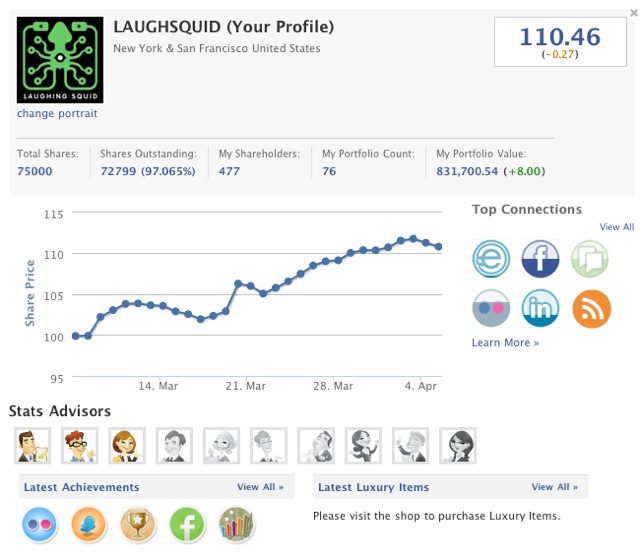
Alea are game mechanics that use speculation, gamboling and chance to engage target audiences. The potential to use luck oriented design paradigms could range from casino like gamboling to lotto games. An example of using Alea gamification would be Empire Avenue, where there is a stock exchange system that naturally induces speculation.

The third type of game-play is Mimesis, which has the user role-play to increase engagement in the non-game system. One could imagine that Mimesis design would feel more like a real game than other forms of gamification. For this reason something like Second Life, which was previously regarded as a serious game, is best considered a gamified social network.Another example of a Mimesis gamification would be the PlayStation®Home. In both examples the platform acts as a gateway to playing embedded games, but embedding games into a platform is not gamification. For example, Kongregate and Steam offer similar functionality, but are clearly not gamified by Mimesis. 


Illinx gamification uses euphoria, vertigo and altered states of perception to engage target groups. We may well imagine that games of this type reward the player by euphoric feeling (when children get recess period at school) or by challenges the player to remain in control under vertigo (being on a roller coaster). An example of this form of gamification would be the transfer accelerator

It should be obvious that the four forms of game play are not isolated or holy, and often coeist in a single design (e.g. Empire Avenue incorporates Agon- Alea) From these four basic forms Caillois combines them in an extended theory of six more forms of game play [3], which becomes interesting if you want a more concise taxonomy for analyzing forms of gamification. Unfortunately, that is outside the scope of this post, which simply attempts to inspire a consideration for other gamification design paradigms.


[2] Zichermann, G (2011) 7 Winning Examples of Game Mechanics in Action, http://mashable.com/2011/07/06/7-winning-examples-of-game-mechanics-in-action/

Monday, May 23, 2011

Quality, Frequency and Clarity: Understanding Play Mechanics

Play mechanics [1] are concerned with how the player interacts with the mechanics of a game. From the player’s perspective this is what he does, including his  actions,  strategies and mental model he forms while playing the game. My model of a play mechanic offers an anatomy of choice, goal, and action. Not too different from the model of interaction[2].


Yet as a game designer I feel that a play mechanic is more than just good interaction, rather a game offers a unique brand of interaction otherwise recognized as play. It is during this cycle between the player and the game’s mechanics that I believe we can find recurring themes found in game design literature. Themes such as: flow and feel, control and actions, information systems and choices, goals and rewards, learning curves and pacing. [1][3][4][5][6]

The purpose of my play mechanic model is to unify these theories and provide a simplified overview. As a part of what I call the aims of game design, the play mechanic model is the second one in a series of three. An important part of play mechanics is how the game mechanics are designed, but where my approach isolates the game mechanics from the player interaction, play mechanics takes this next step.

In a nutshell, my theory is that play mechanics have quality, frequency and clarity. Quality is value that the player places on differentiation in a play mechanic’s choices, goals, and actions. Frequency is the rate in which players encounter a play mechanic’s choices, goals, and actions. Clarity is the obviousness in which players understand the play mechanic’s choices, goals, and actions.


Below I put some of these concepts into a matrix:

Choice
Goal
Action
Quality
- Hollow
- Obvious
- Dramatic
- Weighted
- Immediate
- Long-term
- Orthogonal
 [1][2]
- Easy
- Hard
- Status
- Increased Ability
- Sustenance
- Progression
- Completion
[7]

- positive
- negative
[5]
Frequency
- Real-time
- Turn-based
- Hyper-time
- Slow-motion
- Time-limit

- Moment-to-Moment
- Short-term
- Final Outcome
[1][5]
- One-time
- Repeated
- Continuous
[8]
Clarity
- Certain
- Risk
- Uncertain
[5]
- Concrete
- Achievable
- Rewarding
[6]
- indirect
- direct
- simple
- complex
[5][4]

 
The play mechanic model is more than theory, and used to support my design work. I use it to map and analyze the play mechanics. It also forms the basis for gathering data during play-testing sessions. The model becomes a quick reference for much deeper concepts, but concepts that often overlap each other. 

[1] Introduction to Game Development, Second Edition
[2] The Design of Everyday Things
[3] Game Design Workshop, Second Edition: A Playcentric Approach to Creating Innovative Games (Gama Network Series)
[4] 21st Century Game Design (Charles River Media Game Development)
[5] Rules of Play: Game Design Fundamentals
[6] The Art of Game Design: A book of lenses
[7] Swords & Circuitry: A Designer's Guide to Computer Role-Playing Games (Premier Press Game Development)
[8] Fundamentals of Game Design (2nd Edition)


Formal Method

Description
Formal Method is the name given to a set of techniques used in game design taken from game theory, statistical analysis, and probability analysis. The methods are used to determine game balance, player strategies, player choices, and game mechanics. 

Methods

Sunday, April 17, 2011

Quick Concept Format: A Method for Developing Game Concepts

I use this method along with other ideation methods (i.e. brainstorming). Why do I use it?
  • It’s better suited for iteration.
  • It’s focused on creating a game concept, not a bunch of loose random ideas for features.
  • It lets the individual take time to germinate game concepts.
    The first part of this method believes that the concept process should be iterative. While many sources talk about iterative approaches to design and development, I believe this should be an universal approach—  from ideation-to-design-to-tuning of a game. Having a method that allows participants to create quick game concepts by using a template, provides an easy way to keep track of concepts and facilitates an iterative process.

    Ideation if not focused correctly can develop concepts but leave the important questions that lead to a design unanswered. For that reason the this method focuses on the creation game concepts, not just a bunch of loose ideas for features. Too often, concepts are chosen that are too vague, which result in a series of brainstorms, design sessions, meetings and pitches. Generally, the concept is then reinvented, during a pseudo design-ideation period, which translate into a waste of time and loss of focus.

    Most brainstorming methods focus on fast-group-procreation of concepts, this method encourages slow-individual-germination of game concepts. Allowing people to have time to let ideas “sink in” and “pop-up” is essential to this method. The goal of the method is to allow individuals to collect ideas and guide them towards a game concept.

You can access the Quick Concept Format worksheet here.

How to use:
  1. Give your concept a working title. 
  2. Use the QCF to write a few sentences per category about your game concept. (Note: It is okay if you can't fill it all in, maybe someone else will help provide that part of the concept or you can barrow from someone else's concept.) 
  3. Allow participants to take this home over one night or even a few days. 
  4. Allow participants to present their concepts. 
  5. Follow this up with selection of a game concept or a new round of brainstorming sessions.
The QCF is the result of four years of iterations on a concept that uses a framework to communicate elements of a game and its design. Up to now it has been used during the development of three serious games and several workshops. I recommend this method in combination with worksheets, emails, forums, wikis, blogs, concept documentation, and mind maps.

    The QCF is also an excellent tool for aiding designers in structuring discussions about design. This helps to avoid situations where you as a designer here something like, “ I don’t like zombies”. The QCF helps to determine what this objection is really about. Is it just the theme? Is it how most game progress during a zombie game? Is it in relation to the core mechanics? Is some subjective association the person has with zombie games in general? Is it a issue with how your technology handles the concept behind zombies?

Play-testing

Description:
Play-testing is the name given to a set of methods that use various techniques of observation and capturing data about a player's game-play experience. Game design play-tests can be used to focus on the analysis of a game's usability, prototype, balancing, levels, etc. Most play-testing methods share a few common concepts:
  • Let the players play the game without little or no interference
  • Don't make excuses for the game
  • Collect play-test data objectively

Methods:

Saturday, March 19, 2011

The Game Atom: The fabric of game mechanics

What is a game mechanic? There are several definitions. All of them different. As a game designer and teacher I have been frustrated with the vagueness of the term. If you are interested in the current discourse about game mechanics you may wish to check these out:
Wikipedia: Game Mechanics
Defining Game Mechanics
Game Development Essentials: Gameplay Mechanics
Introduction to Game Development, 2nd Edition

The purpose of this post is not to identify or define game mechanics but rather explore the most basic structure of the game mechanic. I term this structure as the game atom. The game atom represents an essential pattern within all game mechanics.

The game atom exits out of five main elements. These being objects, attributes, procedures, players, time and space. Objects are often represented in games by avatars, enemies, traps, bosses, units, weapons, ammo, power-ups, pick-ups, etc. All objects have a number of attributes, which determine or influence the speed, health, damage, life, ammo, etc. of the object to which they are attached. Objects and their attributes interact through procedures, which can be related to actions or events in a game such as select, move into, trigger, shoot, hit, punch, kick, take damage, pick-up ammo, game over, etc. Procedures can also be designed to stimulate social interaction between players, which is essentially a second order procedure that only the players can resolve. Examples of social procedures would be multi-player, cooperation, voting, biding, etc. Players represent either people or some sort of heuristic or procedural A.I. (artificial intelligence), which then determine the control of related game procedures, objects and their elements. Finally, these elements exist with the constants of time (turns, timed limits, rhythm, rate of fire, delay after attack, etc.) and the limits of the space (location, worlds, maps, boards, fields, levels, screens, etc.) that they occupy.

Together all these elements represent what I have termed the game atom. Beyond attempting to describe the most basic elements of a game mechanic, this model forms the framework for my flowcharting and design document methods. The game atom is also the first layer in my model of understanding game design, which I call the aims of game design. Besides game mechanics, the ‘aims’ also include the play mechanics and game-play experience layers.

The game atom is a practical tool and it can help map out game mechanics. Game mechanics themselves have a tremendous variety and even small variations in seemingly like mechanics can be seen as entirely different mechanic. We must realize that the game mechanic is actually a subjective attempt at describing some of the recurring patterns that can be found in game design. If you are interested in a catalog of these patterns I suggest reading Patterns in Game Design (Game Development Series)by Bjork and Holopainen.

Game Taxonomy

Description
Taxonomy is the name given to a set of methods that provide ways to classify games. Using this as a game design tool provides the game designer with way to categorize games, analyze games, and form a lexicon.

Methods

Saturday, February 12, 2011

The Game Jam: As a Business Model

 A game jam is where a game developer or development team tries to make a game in a short period of time. The format doesn’t necessarily have a standard amount of time or a specific  number of participants. The game jams in which I have participated have lasted for 6hrs to 48hrs and ranging from two to six man teams. There is a variation of the game jam that I term as the game storm, which focuses on only creating game concepts. In the past game jams were a form of geekathlon, but this iron geek event is no longer just to showing off. But seen from a different perspective game jams offer new business opportunities. In the following I use scenarios to describe my theoretical usage of the game jam and game storm.

Scenario 1: A city or a region wants to stimulate industry growth. Solution, hold a game jam. Help the winners to obtain subsidies and/ or loans, as well as consultants that can help them with a business plan.

Scenario 2: A company is looking for talented game developers. Solution, hold a game jam. Have your recruiter at the game jam. Not only will you get an impression of their hard skills, but also an impression of their soft skills, such as their ability to work with others and their enthusiasm for making games.

Scenario 3: A game studio or publisher is looking for inspiration or innovation. Solution, hold a game jam or a game storm. Good old fashion brainstorming might just not cut it, why not invite some fresh blood to get your blood boiling again?

Scenario 4: You or your organization are interested in potentially using applied games, but you don’t really know how a game can be applied to your domain or goals. Solution, hold a game jam or a game storm. Use students and companies to show you how they would potentially  handle your problem with a game.

Scenario 5: Your studio has just hired new employees in the middle of a project and need them to be up to speed as soon as possible. Surprise! Hold a game jam. What better way to indoctrinate people into the company’s way of working.

Scenario 6: You have a game event, and you want live entertainment. Surprise, again! Hold a game jam. You could also tie the game jam to different sponsors where the jammers need to use their technology to show it off.

Friday, February 4, 2011

Game Design Tools for Game Jams

Game jams are great for flexing your game design skills. They are a sort of pressure cooker where all your skills are tested to the extreme. More importantly they offer the designer a chance to own up to his (her) short comings, which often has to do with unrealistic design scope, the inability to kill your darlings and communicating the design. Finally, game jams are a chance to test out the various game design tools and building a better understanding of how they can help.

A game jam doesn’t allow a game designer much luxury qua time, resources and scope. That means that the design tools that you choose must be chosen for- and used with efficiency. In this rant I have reflected on my past game jam experiences and try to pen-point my general game design methodology (or in other words a series game design methods).

Concept Framework

Description:
Concept Framework is the name I have given to approaches that focus on how best to communicate a game concept and the methods that support this (e.g. guidelines, templates, presentations, or rules).

As a game design tool, a concept framework helps formulate tangible ideas, which allows others to evaluate them easier. A concept framework works best as a tool for the concept phase of the game design process, but can also be used as a way to later evaluate your design during the design and tuning phases to determine how much as changed since the original idea. Because most game development is dependent on a concept being accepted by a publisher, a developer, a producer, a development team, a commissioner, crowd sourcing, etc. it is important to be able to communicate it in the best possible way. Having a framework helps provide some standards in what and how a concept is communicated.

Use:
(1) High vs. Low
A concept framework may focus on helping the designer communicate a high-level (brief) or low-level (detailed) game concept. During the process a designer can move from high-level to low-level with any concept. The advantage of high-level concepts is that you can potentially create several in a short period of time, while low-level concepts require more time cover the details about the game development (e.g. game-play, narrative, tech issues, etc.).

(2) Pitches or Documentation
Some concept frameworks focus on documentation or presentations. In general, the guidelines provided by these approaches provide the essentials for communicating the game concept. Documentation can range from single pitch sentence to 4-5 page concept document.


Saturday, January 29, 2011

Game-play, the New Fun

Recently I went to a local symposium on game-play, and while I enjoyed it, I was hoping for a bit more. It is always great to hear the different perspectives on game design, but game-play has been used for quite a while. It’s a term that game designers should probably be able articulate clearly, and thus be able to say what it means to them and how they use it. The first mention of game-play according to my research is from Chris Crawford (1982), in which he states the term was already losing its meaning back then to ambiguity. So, after the panel fumbled about with the term for a while, several reoccurring themes did come to light: game mechanics, core game-play, core mechanics, interaction and player experience. Hearing these terms mentioned, I thought that at least someone would mention the MDA model (Hunicke et al. 2006), which I believe to be one of the few concrete steps toward defining not game-play but the aims of game design. The Art of Game Design (Schell 2008) also maps out the aims of game design and serves as a good reference. Unfortunately the way the panel at the symposium attempted to explain what game-play was, one could not help to draw the conclusion that it had become industry jargon for fun.

So, how do I deal with it? From my point of view game-play is something I associate with a player’s perspective on a game. It is a highly subject perspective, and good game-play is in the eye of the beholder. Understanding perspectives is one of the most important skills of a game designer, and understanding the perspective of your intended player audience is the key to creating good game-play. When we discuss games, game-play and game design we must consider that some perspectives (players, researchers, critics, etc.) are outside-looking-in, while the  other perspective (game designers) is inside-looking-out. Therefore as a professional game designer I avoid the term game-play like the plague. My approach consists of understanding that non-game designers will use this term to try to describe what they do not comprehend, but as a game designer I use terms like the ones I describe in ‘A Quick Perspective on the Aims of Game Design’. These help me clearly articulate the different aspects of game design, and eventually help me to provide what my intended player will consider good game-play.
 

Monday, January 24, 2011

Heuristics for Gamification

Theoretically speaking, a game designer is someone who could help you with gamification. A game designer should have a good grasp on how to devise game mechanics, play mechanics and game-play experience. So in other words, a game designer should have more than points, leader boards and achievements up his (her) sleeve. If certain game mechanics are over exploited (e.g. points, achievements, leader-boards, etc.), then gamification could be heading towards a crash (remember the 1980s?). The point being a wider range of approaches towards developing new game-like motivations can be achieved through game design when gamifying an artifact.

Qua game design, I learned a few things from my students and their projects. First, design of gamifiaction is not too different from game design and its processes (development is another issue). Second, current game design tools (e.g. prototyping, brainstorming, mock-ups, player models, design processes and generative research) are very applicable to gamification design. Furthermore, I came across a few lessons learned that I would use as heuristics for future gamification projects:

-        Gamification Design: Gamification does not equal a game.
-        Gamification vs. Communities: Building a community is not game. Building a community is not gamification. (If you need a community to play your game or use product look for existing ones, e.g. facebook).
-        Gamified Competition for Everyone:
1.      Players should feel that they have chance to win.
2.      Players should feel like they are competing against like players.
3.      Holding first place needs to feel like a challenge
-        Achievements and Points: Be careful that these elements retain their value. Too many points or poorly scheduled achievements will undermine their value.
-        One-Game-to-Rule-Them-All: Create a plan for a gamifaction overhaul after a certain amount of time. The game needs to remain fresh to keep old players, which are needed to attract the new players.
-        Let the Players have all the fun: Gamification can even take advantage of user created content.