Micah Hrechovscik CDP lecture 6-12-2012 from Cdp Hku on Vimeo.

Showing posts with label Rants. Show all posts
Showing posts with label Rants. Show all posts
Monday, March 25, 2013
Tuesday, July 31, 2012
Games vs. Play
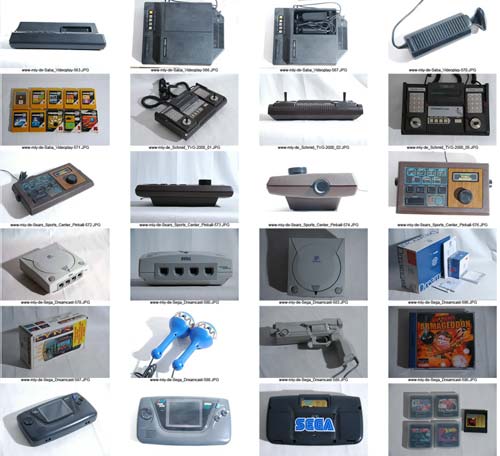 |
| Game Specific Hardware |
Games now influence the whole of interactive media. At first games encouraged the development of a wide range hardware to support them. Then it encouraged a wide range of game controllers to be able to play them. Currently, it as led to motion control like the Kinect. Games have also influenced the use of interactive media in the realm of what was once e-learning, and offered serious games. Games are even going so far as to influence perspectives on pedagogy. They have even inspired gamification, which uses game principles as a means to revitalizing interactive systems, new technology, marketing and creating a higher rate of user motivation.
 |
| Making Serious Games |
 |
| Dice for Change [3] |
 |
| Playing with Pigs [2] |
[1] Man, Play and Games

[2] Playing with Pigs
[3] Dice for Change
[4] Play: How it Shapes the Brain, Opens the Imagination, and Invigorates the Soul

[5] 8KindsOfFun

Monday, May 21, 2012
Using Narratives as Game and Play Mechanics
I typically hold to a 'stories are not games' and 'games are not stories' rhetoric, however there is a grey area in the discussion of narration and game design. Recently
I was reading some blogs and articles about games and narratives. I was a bit disappointed because if we analyzed
these current discussions, I think that we would find very little progress
in the general knowledge concerning narratives in video games and what this means to the game’s
design. The typical discourse ranges from narratives are essential to video games, video games are narratives, and video games don’t need narratives. The
purpose of this post is to examine the narrative from a game design
perspective. In this post I specifically focus on two types of narrative game and play mechanics.

For
the most part narratives and games are treated as two separate entities in game design theory, which is not strange because both games and narratives
are both trans-medial. Meaning that they can be experienced in various forms of
media. For narratives this means: books, films, verbal storytelling, etc. And
for games this means: physical activity, computers, board and card games, etc. Typically
a game's narrative has no relationship to the game's play expect for attempting to
give the overall game-play experience more depth. For example, if you were to
skip through the narrative of these games the game could still be completed. Often these game-play experiences feel disjointed which is caused by the conflict between game and narrative. One such pitfall occurs when narrative takes away the control from the player, which is the essential aspect of all games (e.g. even if it is only rolling dice for a random result), especially when the narrative takes away interesting choices from the player. Furthermore, cut-scenes should be a moment for the narrative to elaborate on changes due to the player’s actions or build the context in which the game action is taking place. Lastly, I think that one of biggest pitfalls is when the narrative animation is more exciting than the game action...
Only if the player could find this kind of action in-game...
 |
| Zork is an old school text adventure game |
The narrative game and play mechanic challenges the player's ability to comprehend
the narrative. Unlike traditional narratives where the reader/viewer is never asked if
he/she is able to follow the story line to continue. The play mechanics can be adjusted
to make a narrative game mechanic more challenging by time pressure, providing goals
(e.g. dilemmas, changing the narrative outcome), and frequency in which the
player is confronted with narrative (e.g. critical choices) choices.
 |
| Making decisions in Mass Effect |
The other kind of game mechanic that a narrative can be is a reward, and while this is not much of a surprise, narratives are most often used exactly for this reason (though i wonder how many designers or writers really understand it from this perspective). The play mechanic aspect of this game mechanic can be adjusted to offer the narrative in various forms of reward schedules (e.g. random, timed, paced, etc.) and provide a context for the ultimate game goal (e.g. finishing the game). In other words a narrative can be used exactly how other rewards are designed into a game. I believe the reward of a narrative is especially strong if it is able to provide the proper cliffhangers at each point it is introduced.
I am
sure that there are more ways in which elements of a narrative can become game
mechanics. My conclusion is that designers and writers could become more aware
of this phenomenon and take advantage of how games and narrative are blended. Furthermore,
I hope this can help solve the conflict between designers and writers who see
video games as either narrative or game-play.
Friday, April 13, 2012
Core & Progressive Game Mechanics
 |
| Core and Progressive Mechanics |
Why are these important concepts to my game design theory? Having the concepts of core and progressive mechanics allows me to analyze game design by separating and isolating the game mechanics. By creating categories and definitions I create a framework, which I can use to create dialogues about a game's design during development. Having this form of communication can help keep designers and developers from confusing issues concerning the game design.
Another reason is that the more complex a game is, the more chance of losing sight of what is central to the design. Design pitfalls like feature creep is direct result of not be able to identify the core or progressive mechanics of game. In other words it is not knowing what is fundamental about the design of the game you are working on, and then trying to fix it with more and more features.
Attempts to define core-mechanics define them as being the challenge to the player and the player's actions [1], while others define it as only the player's actions [2]. I. Barry [3] defines the them as one or more fundamental actions (or set of actions) that characterize the typical activities engaged by the player. In addition, to this later definition, and that helps to further isolate the core mechanic is that it is an action the player must most often repeat [4].
Here are the key concepts:
- Related to the player's action(s)
- An action or set of actions
- Actions that must be often repeated
In my definition I include the space where the core mechanic occurs as an aspect any core mechanic. So, that my definition would be something like this: The core mechanics of a game is defined by the space in which one or more game mechanics are actions most often repeated by the player.
 An example of a complex set of core mechanics can be seen in the game of chess, where its core is built into a player's turn and consist of choosing to move one of sixteen game pieces and depending on the game piece allowing for seven different moves.
A simple set of game mechanics can be found in the game of checkers, which has twelve game pieces of one type that follows the same set of movement rules.
 In a game like Pacman the core mechanic is horizontal and vertical steering (because Pacman always is always moving under his own power) based on the layout of the maze. We could argue that an extended feature and a potentially core mechanic on its own is the chasing and eating of the ghosts.
 Progressive Mechanics is a term that my former colleague K. Millenaar defined during his post graduate research. While it is not a term or concept that is used in current game design discourse or literature, there are some connections to similar concepts and terms.
One such connection is J. Juul's [5] concept of rule structures being progressive or emergent. Another like concept is game structure or how the game and levels are structured [2]. I. Barry [3] mentions systems, which are meant to enable game mechanics. Finally, the concept of progressive mechanics could be described as "...moving us forward, encouraging us to play" [6] and linked to concepts like goals, rewards, challenges, and even economies.
Here are the basics of the progressive mechanic concept:
- Player progression occurs through repetition of the core mechanics
- Encourages the player to move into other game states
- Often related to mechanics dealing with goals, rewards, economies, and challenges
In addition to the above concepts I believe that progressive mechanics have a strong relation to time. So, finally my definition would be something like this: The progressive mechanics of a game are defined by game mechanics that encourage the player to repeat over time the core mechanics.
An example of progressive mechanics in chess is the winning state being checkmate, a progressive mechanic is chess is also how players lose their game pieces. In Pacman the progressive mechanics are the points you can earn, finishing a level, losing lives and the number lives a player has.
Core mechanics has been a prominent concept for several years now and has over shadowed the question of progressive mechanics. In the video game industry it is so much the focus that innovation is only attempted on the core mechanics level, which may explain why so many games regardless of the difference in the core mechanics can seem so much alike. Thinking in terms of progressive mechanics also explains why a stories in games are actually used as mechanics and are so successfully integrated with games. Using a good story is a sure way to vary reward and offer surprises for the continued use of the core mechanics. I would like to believe that once we become aware of the core and progressive mechanics, innovation can occur in both.
[1] Fundamentals of Game Design

[2]Game Development Essentials: Gameplay Mechanics

[3]Introduction to Game Development, Second Edition
[4]Game Design Workshop, Second Edition: A Playcentric Approach to Creating Innovative Games (Gama Network Series)


Wednesday, March 7, 2012
Reinventing Physical Games (a.k.a. sports)
I wanted to continue along the idea of physical games from an earlier post. Already in the last generation many new types of Xtreme sports were invented (e.g. snowboarding) while other sports where reinvented as Xtreme (e.g. skateboarding). In the following examples we see how physical games can be reinvented by the use of some newer technologies. In the first example is Figure Running. In a more extreme example is Tazer Ball.


Saturday, January 14, 2012
A Theory of Physical Applied Games
If we think of games as trans-medial [1], then it is easier to understand how games exist in many forms. For example, one aspect of Lindely’s taxonomy [2] demonstrates how games range from the virtual to the physical, which means chess (a board game), football (played on a field with players), and pacman (played on in a arcade or on a computer) are all games. Yet from a cultural point of view there is a great deal of bias concerning the benefits and harm of virtual and physical gaming. Common bias towards virtual games are that they are a waste of time, linked to violence, and childish [3] [4] [5]. Physical games on the other hand are generally associated with the benefits for one’s health, self esteem, team work, ect. [6], even though there have been enough studies that critique physical games in much the same way as video games [7] especially when concerned with the topic of violence [8] [9].
“Games teach us ‘something’, the matter of the question is what that ‘something’ is?” As my friend and former colleague was fond of saying. Our question, “What are we learning from our physical games?” Many physical games (sports) were originally applied games, meant for archaic martial training (e.g. wrestling, polo, football, field and track, etc.). Ultimately, what I would like us to think about is the design of applied physical games (with or without the aid of new technology) that is aimed at really solving the problems we believe that physical games can solve (i.e. obesity, social problems, etc.) but actually do not. An applied game is a game designed with an ulterior motive, usually aimed at changing the behavior, perspectives or knowledge of the player. My theory is that a well designed applied physical game, not unlike the arguments for using video games [4], could also be a force for changing our world.
[1] Juul, Jesper. Half-Real : Video Games Between Real Rules and Fictional Worlds. New York: MIT, 2005. Print.
[2] Lindley, Craig A. "Gamasutra - Features - Game Taxonomies: A High Level Framework for Game Analysis and Design." Gamasutra - The Art & Business of Making Games. 2003. Web. 23 Mar. 2009. .
[3] Jenkins, Henry. "Reality Bytes: Eight Myths About Video Games Debunked." PBS. Public Broadcasting System. Web. 11 Jan. 2012. .
[4] McGonigal, Jane. Reality Is Broken: Why Games Make Us Better and How They Can Change the World. New York: Penguin, 2011. Print.
[5] Koster, Raph. Theory of Fun for Game Design. Paraglyph, 2004. Print.
[6] Mahoe, Stacy. "7 Good Reasons to Get Your Child Involved in Sports." Coaching Drills, Information and Products For Youth Sports. Web. 11 Jan. 2012. .
[7] Goldstein, Jeffrey H. SPORTS, GAMES, and PLAY Social and Psychological Viewpoints. 2nd ed. Hillsdale, NJ: LAWRENCE ERLBAUM ASSOCIATES, 1989. Print.
[8] Young, Kevin. "15 Sport and Collective Violence." Exercise and Sport Sciences Reviews 19.1 (1991). Print.
[9] Abrams, Mitch. Anger Management in Sport: Understanding and Controlling Violence in Athletes. Champaign, IL: Human Kinetics, 2010. Print.
Thursday, October 6, 2011
A Game Designer's Manifesto: The 7 Virtues of a Desamurai
 I believe that games should entertain players, while
inspiring new perspectives and insights about the world around them. Game
design should be the way to deliberately create game-play experiences, but to
do this a designer must be fluent in his or her design practice. The purpose of
this manifesto is to explore a set of standards that would shape the conduct or
attitude of a designer’s practice.
I believe that games should entertain players, while
inspiring new perspectives and insights about the world around them. Game
design should be the way to deliberately create game-play experiences, but to
do this a designer must be fluent in his or her design practice. The purpose of
this manifesto is to explore a set of standards that would shape the conduct or
attitude of a designer’s practice.
In her post, Respecting
Design, Claire Blackshaw[1] describes something I recognized myself when I
first entered the industry and continue to recognize in many anecdotes from
students that are novice game designers.
In her blog post the essential question is, “Why is it so hard to earn
respect as a game designer?” In fact this issue seems to bother many game designers.
Not too long after I started to write this manifesto, I noticed this article
had been posted on lostgarden.com ‘The
Declaration of Game Designer Independence ‘. [2] While the declaration hits upon many vital points, my
interpretation of the underlining message was a call for respect. Yet, “In most
respected professions a vast amount of research, basis of knowledge, or method
of thinking is required to advance in professional grade problems.”[1] [3] To
gain respect, designers need to be able to demonstrate their abilities clearly
and convincingly. In other words, if they want their independence they will
need to revolutionize their practices in order to earn independence.
My general approach to this issue has been to use and
collect game design methods, but beneath this approach is a doctrine that makes them
work for me. In a tribute to the 7 virtues of Bushido (The Way of the Samurai) the following seven topics of this manifesto has become my Way of the Desamurai.
The heart of development is
game design
Game design is fundamental to game development, not
only because it affects the resulting game-play experience, but because of its
influence on the most crucial aspects of game development. In my opinion these
are time, cost and synergy (synergy meaning the development team’s moral,
enthusiasm, energy and trust). A game designer should be able fit the design to
the available time, resources and synergy. Therefore the ability to estimate
this is essential. As such, a designer cannot use the lack of resources to
explain a poor game-play experience. In the end it’s about achieving the most
with what is available.
Refine over redefine
All game design and development should be iterative. A
designer’s job is to iterate as many times as needed to nail the aims of game
design (game mechanics, play mechanics and game-ply experience). Iterative
design is not a continuous experimentation until the designer stumbles upon the
ultimate game through trial-and-error. Iterations should be about refining
while avoiding a lot of redefining, if too much redefining occurs then pitfalls
like feature creep occur. Instead the designer should strive to reach the
desired game-play experience in shortest number of iterations.
Knowing the
design
Knowing
the design is the most fundamental task of the game designer, which means
knowing how the core- and progressive- mechanics work, how the play mechanics
should feel and having a sense for the game-play experience. Lacking intimate knowledge
of the design can lead to a loss of team synergy and generally making excuses
as to why it’s not fun. If you want to have respect as a game designer you should
know the design inside out, after all if you don’t know the game, who does?
The
Trans-medial game designer
A game
designer should be able to design all sorts of games not just video games. [4] Games
are trans-medial, meaning they transcend any one medium. [5] They exist as
video games, board games, card games, physical sports, social games, and
ubiquitous systems. A designer should avoid be only a ‘fan boy’ designer who only
designs games for his/her favorite genre or media. Once a game designer
embraces the fact that games are trans-medial, it will open your eyes to a
wider application of your game design skills.
Have you
ever been experienced
Ideally,
game design should be an occupation that inspires lifelong learning. Any
designer that maintains this attitude soon finds that they become a
jack-of-all-trades, as they collect experiences and knowledge about design and
the media in which the design was developed. A game designer should above all else play
all sorts of games, not just his/her favorite, and be able to critique these
games beyond terms such as ‘fun’ and ‘good game-play’. My belief is that good
game design comes from being able to portray a game-play experience, therefore
even if a game is a sequel or a clone, a designer should treat the design as
unique and with respect. In these cases just adding new features and mechanics
to an existing game without understanding why the game worked worked in the first place is a
recipe for poor design. Furthermore, genre categorization is
terminology best reserved for sales and players, as a game designer should be
able to understand games in terms of game mechanics and systems. By
understanding the mechanics the designer always starts from scratch and applies
mechanics as needed and not because of genre conventions.
Design vs. Game
A game
designer should always remember that the game design is not the game and the
game is the design. I know this sounds weird but game designers tend to confuse
what is designed and what is built, and then believe these should be the same. The goal
of all design activities should be aimed at making a game with the best
possible game-play experience. Therefore a designer needs to realize that much
of his work is expendable. That is because most of our work is only foot work,
and in the end there is a good chance of it being scraped, changed or not being
implemented.
Listen,
Explain, Inspire
The ability
to communicate is critical. Good communication begins with listening to others,
and as a designer this means listening to your players, development
team, publisher, etc. The next aspect of communication is knowing how to
provide the proper explanations that will help others implement the design,
while providing clear argumentation for your design choices. The final aspect
of communication is about inspiring others which means promoting the design to
the development team, producers, players, etc.
Tuesday, September 20, 2011
Applied Game Design Transfer
Applied game design is about creating a game to accomplish a predetermined purpose outside its game-play. The ‘predetermined purpose’ has also been called 'serious', and thus making it easy to confuse it with meaning 'not fun', ‘applied’ simply indicates that the game is used as a vehicle. As a vehicle, the game is designed to transfer thoughts, information, ideas, beliefs, insights, explanations, experiences, competencies (both mental and physical) and change behavior. In this post I want to create an awareness of an applied game’s direction of transfer, which I believe is helpful for creating a high-level understanding an applied game's potential and piece to a taxonomy for applied games.

In the above image I argue that applied games can: transfer-out, transfer-in, transfer-facilitate and transfer-through. First, the conventional view of the applied game is concerned with transfer that flows in the direction of the player. For example, here are two games that focus on transfer-out, both of which I was directly involved in designing. Carkit is a game that is meant to help teach high school students Newtonian physics, while the Burgemeestergame is meant to help train Dutch mayor’s in crisis management.
 |
| Carkit |
 |
| Burgemeestergame |
Next, transfer-in is a form of applied game where transfer comes from the players. This form of applied game is beginning to gain more popularity, and has been the topic of several meetings where I consulted. As examples, I will use two fairly well known applied games. Foldit is a game meant to generate the evidence needed to prove that human protein folders can be more effective than computers at certain aspects of protein structure prediction. While playing the ESP game of labeling images, you are training computers to solve problems for humans.
 |
| Foldit |
 |
| ESP Game |
Transfer-facilitate would be an applied game
that transfers back and forth between player and game commissioner.
Unfortunately, I have no examples of this type of applied game. I do think it should
be a fairly obvious possibility, and if anyone reading this has one, then
by all means please leave a reply to this post.
The last type of transfer is transfer-through, which is transfer that designers receive and transmit during the game design process. Transfer is not necessarily a result of playing, but of
designing a game which may or may not actually result in a finalized version of
a game since the predetermined purpose is achieved during its design. The designers in this process need not be professional game designers but can be ad-hoc game designers (e.g. specialists, co-workers, content experts, clients, target audience, etc.). Examples of this form of transfer can be found in the writings of pioneering serious game thinkers such as Clark Abt and Richard Duke.
Friday, August 5, 2011
Gamification Design: A Caillois of Possibilities
“Gamification is the use of game thinking and game mechanics to engage audiences and solve problems.” [1][2] A wide range of industries (i.e. technology, health care, education, consumer products, entertainment and travel) see the potential of gamification as way to facilitate transfer (e.g. loyalty, a particular message, social interaction, knowledge, etc.) by enhancing or extending the engagement of targeted audiences (i.e. employees, students and consumers). From a game designer’s perspective it is an opportunity to expand one’s expertise and role into these industries.
The question is, what kind of game-play experiences can we stimulate with gamification? I believe that a good game provides an experience that inspires the player, and good gamification should also strive to achieve meaningful experiences. Gamification design is more than adding points and badges, and as design paradigms represent only the tip of the ice berg. We should be aware of all the design possibilities; therefore I offer this taxonomy of gamification possibilities based on Caillois’s four forms of play found in games. Caillois was a French intellectual that brought together literary criticism, sociology, and philosophy [3], he should be known to most game designers and is canon for game studies. In his book Man, Play and Games , he identified four forms play in games:
The question is, what kind of game-play experiences can we stimulate with gamification? I believe that a good game provides an experience that inspires the player, and good gamification should also strive to achieve meaningful experiences. Gamification design is more than adding points and badges, and as design paradigms represent only the tip of the ice berg. We should be aware of all the design possibilities; therefore I offer this taxonomy of gamification possibilities based on Caillois’s four forms of play found in games. Caillois was a French intellectual that brought together literary criticism, sociology, and philosophy [3], he should be known to most game designers and is canon for game studies. In his book Man, Play and Games
, he identified four forms play in games:Agon, or competition.
Alea, or chance.
Mimesis, or mimicry, or role playing.
Ilinx, or vertigo, in the sense of altering perception.
I would argue that current gamification design discourse emphasizes Agon type game mechanics, where gamification creates competition. While leader boards are obvious forms of competition, achievements and points are more subtle but create status that motivates competition. Competition is not just multi-player, but also exists in single player games where players try to beat their high score. Some examples of Agon gamification would be something like foursquare and ContinentalAirlines- OnePass Frequent Flyer Program.

Alea are game mechanics that use speculation, gamboling and chance to engage target audiences. The potential to use luck oriented design paradigms could range from casino like gamboling to lotto games. An example of using Alea gamification would be Empire Avenue, where there is a stock exchange system that naturally induces speculation.
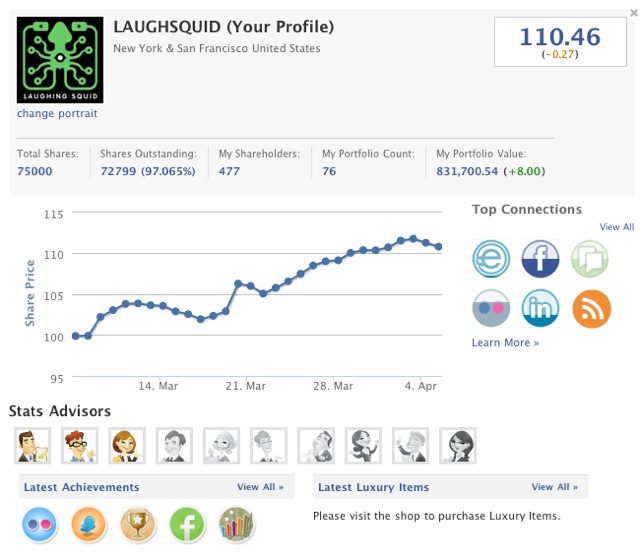
The third type of game-play is Mimesis, which has the user role-play to increase engagement in the non-game system. One could imagine that Mimesis design would feel more like a real game than other forms of gamification. For this reason something like Second Life, which was previously regarded as a serious game, is best considered a gamified social network.Another example of a Mimesis gamification would be the PlayStation®Home. In both examples the platform acts as a gateway to playing embedded games, but embedding games into a platform is not gamification. For example, Kongregate and Steam offer similar functionality, but are clearly not gamified by Mimesis.


Illinx gamification uses euphoria, vertigo and altered states of perception to engage target groups. We may well imagine that games of this type reward the player by euphoric feeling (when children get recess period at school) or by challenges the player to remain in control under vertigo (being on a roller coaster). An example of this form of gamification would be the transfer accelerator.

It should be obvious that the four forms of game play are not isolated or holy, and often coeist in a single design (e.g. Empire Avenue incorporates Agon- Alea) From these four basic forms Caillois combines them in an extended theory of six more forms of game play [3], which becomes interesting if you want a more concise taxonomy for analyzing forms of gamification. Unfortunately, that is outside the scope of this post, which simply attempts to inspire a consideration for other gamification design paradigms.
[2]  Zichermann, G (2011) 7 Winning Examples of Game Mechanics in Action, http://mashable.com/2011/07/06/7-winning-examples-of-game-mechanics-in-action/
Zichermann, G (2011) 7 Winning Examples of Game Mechanics in Action, http://mashable.com/2011/07/06/7-winning-examples-of-game-mechanics-in-action/
Monday, May 23, 2011
Quality, Frequency and Clarity: Understanding Play Mechanics
Play mechanics [1] are concerned with how the player interacts with the mechanics of a game. From the player’s perspective this is what he does, including his actions, strategies and mental model he forms while playing the game. My model of a play mechanic offers an anatomy of choice, goal, and action. Not too different from the model of interaction[2].

Yet as a game designer I feel that a play mechanic is more than just good interaction, rather a game offers a unique brand of interaction otherwise recognized as play. It is during this cycle between the player and the game’s mechanics that I believe we can find recurring themes found in game design literature. Themes such as: flow and feel, control and actions, information systems and choices, goals and rewards, learning curves and pacing. [1][3][4][5][6]
The purpose of my play mechanic model is to unify these theories and provide a simplified overview. As a part of what I call the aims of game design, the play mechanic model is the second one in a series of three. An important part of play mechanics is how the game mechanics are designed, but where my approach isolates the game mechanics from the player interaction, play mechanics takes this next step.
In a nutshell, my theory is that play mechanics have quality, frequency and clarity. Quality is value that the player places on differentiation in a play mechanic’s choices, goals, and actions. Frequency is the rate in which players encounter a play mechanic’s choices, goals, and actions. Clarity is the obviousness in which players understand the play mechanic’s choices, goals, and actions.

Below I put some of these concepts into a matrix:
Choice | Goal | Action | |
Quality | - Hollow - Obvious - Dramatic - Weighted - Immediate - Long-term - Orthogonal [1][2] | - Easy - Hard - Status - Increased Ability - Sustenance - Progression - Completion [7] | - positive - negative [5] |
Frequency | - Real-time - Turn-based - Hyper-time - Slow-motion - Time-limit | - Moment-to-Moment - Short-term - Final Outcome [1][5] | - One-time - Repeated - Continuous [8] |
Clarity | - Certain - Risk - Uncertain [5] | - Concrete - Achievable - Rewarding [6] | - indirect - direct - simple - complex [5][4] |
The play mechanic model is more than theory, and used to support my design work. I use it to map and analyze the play mechanics. It also forms the basis for gathering data during play-testing sessions. The model becomes a quick reference for much deeper concepts, but concepts that often overlap each other.
[1] Introduction to Game Development, Second Edition
[2] The Design of Everyday Things
[3] Game Design Workshop, Second Edition: A Playcentric Approach to Creating Innovative Games (Gama Network Series)
[4] 21st Century Game Design (Charles River Media Game Development)
[5] Rules of Play: Game Design Fundamentals
[6] The Art of Game Design: A book of lenses
[7] Swords & Circuitry: A Designer's Guide to Computer Role-Playing Games (Premier Press Game Development)
[8] Fundamentals of Game Design (2nd Edition)
[1] Introduction to Game Development, Second Edition
[2] The Design of Everyday Things
[3] Game Design Workshop, Second Edition: A Playcentric Approach to Creating Innovative Games (Gama Network Series)
[4] 21st Century Game Design (Charles River Media Game Development)
[5] Rules of Play: Game Design Fundamentals
[6] The Art of Game Design: A book of lenses
[7] Swords & Circuitry: A Designer's Guide to Computer Role-Playing Games (Premier Press Game Development)
[8] Fundamentals of Game Design (2nd Edition)
Sunday, April 17, 2011
Quick Concept Format: A Method for Developing Game Concepts
I use this method along with other ideation methods (i.e. brainstorming). Why do I use it?
Ideation if not focused correctly can develop concepts but leave the important questions that lead to a design unanswered. For that reason the this method focuses on the creation game concepts, not just a bunch of loose ideas for features. Too often, concepts are chosen that are too vague, which result in a series of brainstorms, design sessions, meetings and pitches. Generally, the concept is then reinvented, during a pseudo design-ideation period, which translate into a waste of time and loss of focus.
Most brainstorming methods focus on fast-group-procreation of concepts, this method encourages slow-individual-germination of game concepts. Allowing people to have time to let ideas “sink in” and “pop-up” is essential to this method. The goal of the method is to allow individuals to collect ideas and guide them towards a game concept.
You can access the Quick Concept Format worksheet here.
How to use:
The QCF is also an excellent tool for aiding designers in structuring discussions about design. This helps to avoid situations where you as a designer here something like, “ I don’t like zombies”. The QCF helps to determine what this objection is really about. Is it just the theme? Is it how most game progress during a zombie game? Is it in relation to the core mechanics? Is some subjective association the person has with zombie games in general? Is it a issue with how your technology handles the concept behind zombies?
- It’s better suited for iteration.
- It’s focused on creating a game concept, not a bunch of loose random ideas for features.
- It lets the individual take time to germinate game concepts.
Ideation if not focused correctly can develop concepts but leave the important questions that lead to a design unanswered. For that reason the this method focuses on the creation game concepts, not just a bunch of loose ideas for features. Too often, concepts are chosen that are too vague, which result in a series of brainstorms, design sessions, meetings and pitches. Generally, the concept is then reinvented, during a pseudo design-ideation period, which translate into a waste of time and loss of focus.
Most brainstorming methods focus on fast-group-procreation of concepts, this method encourages slow-individual-germination of game concepts. Allowing people to have time to let ideas “sink in” and “pop-up” is essential to this method. The goal of the method is to allow individuals to collect ideas and guide them towards a game concept.
You can access the Quick Concept Format worksheet here.
How to use:
- Give your concept a working title.
- Use the QCF to write a few sentences per category about your game concept. (Note: It is okay if you can't fill it all in, maybe someone else will help provide that part of the concept or you can barrow from someone else's concept.)
- Allow participants to take this home over one night or even a few days.
- Allow participants to present their concepts.
- Follow this up with selection of a game concept or a new round of brainstorming sessions.
The QCF is also an excellent tool for aiding designers in structuring discussions about design. This helps to avoid situations where you as a designer here something like, “ I don’t like zombies”. The QCF helps to determine what this objection is really about. Is it just the theme? Is it how most game progress during a zombie game? Is it in relation to the core mechanics? Is some subjective association the person has with zombie games in general? Is it a issue with how your technology handles the concept behind zombies?
Saturday, March 19, 2011
The Game Atom: The fabric of game mechanics
What is a game mechanic? There are several definitions. All of them different. As a game designer and teacher I have been frustrated with the vagueness of the term. If you are interested in the current discourse about game mechanics you may wish to check these out:
Wikipedia: Game Mechanics
Defining Game Mechanics
Game Development Essentials: Gameplay Mechanics
Introduction to Game Development, 2nd Edition
The purpose of this post is not to identify or define game mechanics but rather explore the most basic structure of the game mechanic. I term this structure as the game atom. The game atom represents an essential pattern within all game mechanics.

The game atom exits out of five main elements. These being objects, attributes, procedures, players, time and space. Objects are often represented in games by avatars, enemies, traps, bosses, units, weapons, ammo, power-ups, pick-ups, etc. All objects have a number of attributes, which determine or influence the speed, health, damage, life, ammo, etc. of the object to which they are attached. Objects and their attributes interact through procedures, which can be related to actions or events in a game such as select, move into, trigger, shoot, hit, punch, kick, take damage, pick-up ammo, game over, etc. Procedures can also be designed to stimulate social interaction between players, which is essentially a second order procedure that only the players can resolve. Examples of social procedures would be multi-player, cooperation, voting, biding, etc. Players represent either people or some sort of heuristic or procedural A.I. (artificial intelligence), which then determine the control of related game procedures, objects and their elements. Finally, these elements exist with the constants of time (turns, timed limits, rhythm, rate of fire, delay after attack, etc.) and the limits of the space (location, worlds, maps, boards, fields, levels, screens, etc.) that they occupy.
Together all these elements represent what I have termed the game atom. Beyond attempting to describe the most basic elements of a game mechanic, this model forms the framework for my flowcharting and design document methods. The game atom is also the first layer in my model of understanding game design, which I call the aims of game design. Besides game mechanics, the ‘aims’ also include the play mechanics and game-play experience layers.
The game atom is a practical tool and it can help map out game mechanics. Game mechanics themselves have a tremendous variety and even small variations in seemingly like mechanics can be seen as entirely different mechanic. We must realize that the game mechanic is actually a subjective attempt at describing some of the recurring patterns that can be found in game design. If you are interested in a catalog of these patterns I suggest reading Patterns in Game Design (Game Development Series) by Bjork and Holopainen.
Wikipedia: Game Mechanics
Defining Game Mechanics
Game Development Essentials: Gameplay Mechanics
Introduction to Game Development, 2nd Edition
The purpose of this post is not to identify or define game mechanics but rather explore the most basic structure of the game mechanic. I term this structure as the game atom. The game atom represents an essential pattern within all game mechanics.

The game atom exits out of five main elements. These being objects, attributes, procedures, players, time and space. Objects are often represented in games by avatars, enemies, traps, bosses, units, weapons, ammo, power-ups, pick-ups, etc. All objects have a number of attributes, which determine or influence the speed, health, damage, life, ammo, etc. of the object to which they are attached. Objects and their attributes interact through procedures, which can be related to actions or events in a game such as select, move into, trigger, shoot, hit, punch, kick, take damage, pick-up ammo, game over, etc. Procedures can also be designed to stimulate social interaction between players, which is essentially a second order procedure that only the players can resolve. Examples of social procedures would be multi-player, cooperation, voting, biding, etc. Players represent either people or some sort of heuristic or procedural A.I. (artificial intelligence), which then determine the control of related game procedures, objects and their elements. Finally, these elements exist with the constants of time (turns, timed limits, rhythm, rate of fire, delay after attack, etc.) and the limits of the space (location, worlds, maps, boards, fields, levels, screens, etc.) that they occupy.
Together all these elements represent what I have termed the game atom. Beyond attempting to describe the most basic elements of a game mechanic, this model forms the framework for my flowcharting and design document methods. The game atom is also the first layer in my model of understanding game design, which I call the aims of game design. Besides game mechanics, the ‘aims’ also include the play mechanics and game-play experience layers.
The game atom is a practical tool and it can help map out game mechanics. Game mechanics themselves have a tremendous variety and even small variations in seemingly like mechanics can be seen as entirely different mechanic. We must realize that the game mechanic is actually a subjective attempt at describing some of the recurring patterns that can be found in game design. If you are interested in a catalog of these patterns I suggest reading Patterns in Game Design (Game Development Series)
by Bjork and Holopainen.
Subscribe to:
Posts (Atom)